
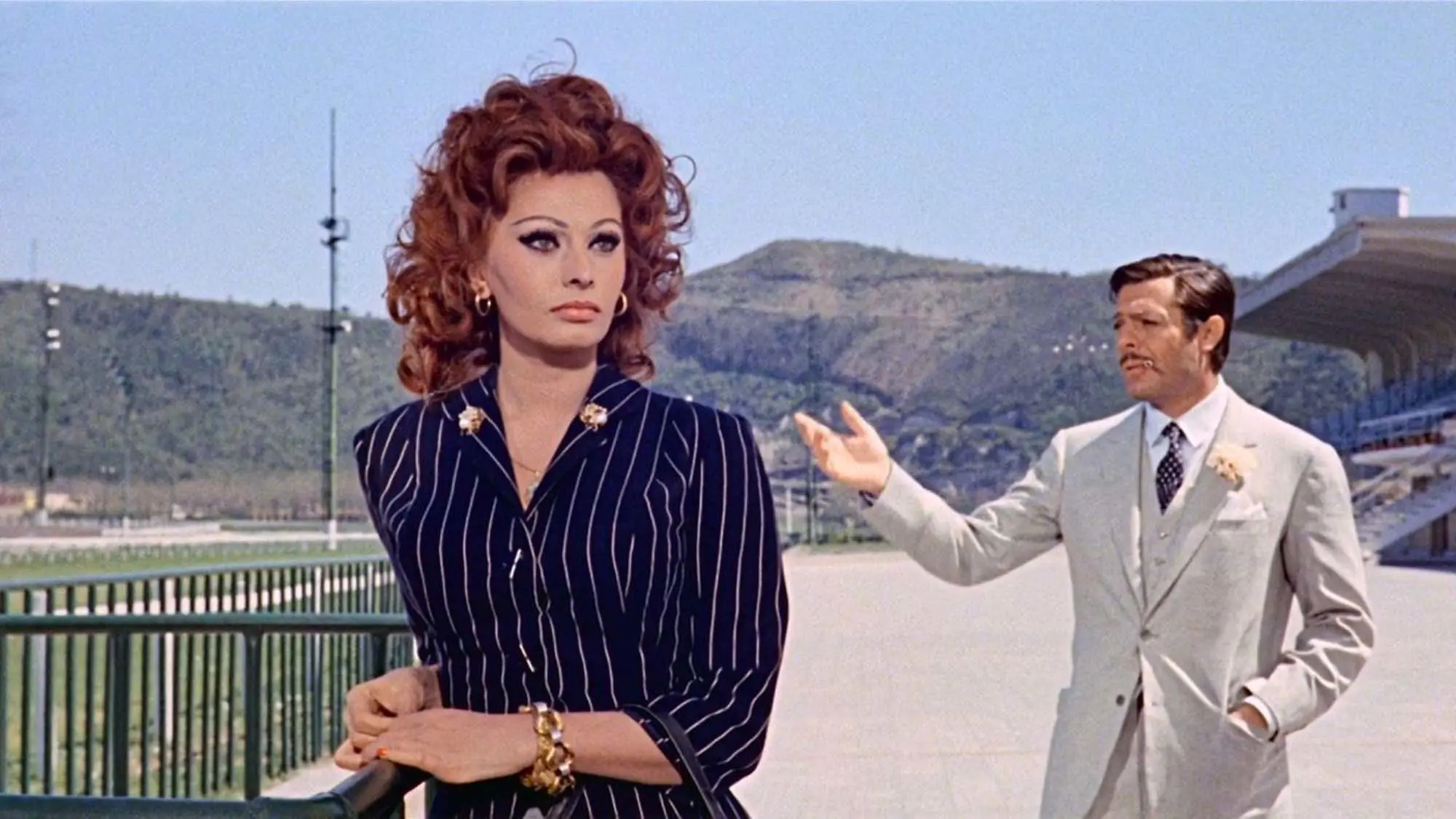
Vittorio De Sica’s 1964 Marriage Italian Style chronicles the story of a couple, from two opportunistic lenses: the man keeping the woman at a distance, eventually manipulating her to serve as his mother’s caretaker; and the woman’s, who needs the institution of marriage and the man’s name to secure a better future for her sons. Both perspectives weigh their inner passions with personal necessity, hesitant to lose track of the rational in pursuit of their passion for one another.
The story begins in media res, with a middle-aged Filumena (Filume’) Marturano (Sophia Loren) on her deathbed, igniting the sympathy and grief of the community around her. They seek out Domenico Sorvano (Marcello Mastroianni) – amid preparations to marry a much younger woman – and summon him to her bedside. Domenico recalls decades earlier during World War II, first meeting Filume’ in the brothel she works in, where the two find shelter from the bombings. After the war ends and the years go on, he continues to visit periodically, and she becomes a confident, smiling, lovely woman, though always kept at a distance by Domenico, never fully committing to her. After being confronted by Filume’ he makes a show to prove his love, but with a catch: moving her into an apartment, recently vacated by the death of the previous tenant; and moving her in to live with (and care for) his elderly mother. Her hopes get raised, only to be dashed and disappointed again.
Back in the present, Filume’ commands the priest to marry her and Domenico, and upon their holy matrimony she is conveniently healed of all her ailments, having tricked Domenico into marrying her. She recalls her experience early in their courtship, largely one of loneliness and waiting. She has borne three children, unable to raise them herself, but tries best as possible to remain present in their lives, all while working and living in a brothel. She longs for Domenico to marry her, as security for her sons: the promise of a good name, and the opportunities they would unlock as respected, privileged Sorvano boys.
It’s a prime example of the commedia all’italiana style, with comic elements layered over a fundamentally dramatic, even tragic, scenario. There is clearly romantic chemistry between Filume’ and Domenico, but their ties are less passionate and more out of necessity, with Domenico leaving Filume’ on the side, countering her dream to bring a better life for her sons.
The repression of emotion in favor of the rational, continues through the film’s final moments, with the couple married, and family reunited with three sons. In their apartment overlooking the Piazza Gesu’ Nuovo, Filume’ finally breaks down in tears, admitting “it’s wonderful to cry” – to finally be relieved of years of maternal worries, and secure in her romantic life: a love story decades in the making.
Leave a Reply