
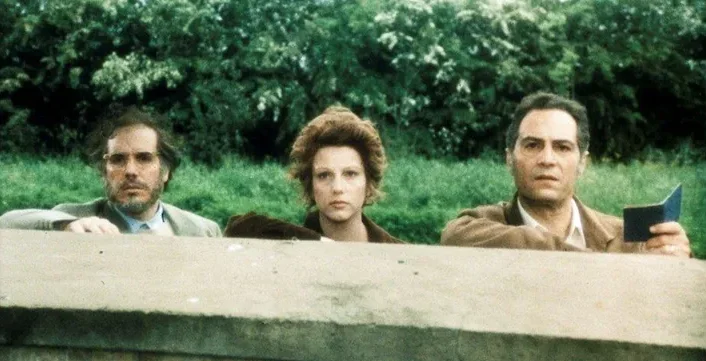
Ettore Scola’s We All Loved Each Other So Much (1974) charts the changing times and media language from World War II through the present-day 1970s. Its lead characters, four friends whose paths intersect throughout the decades, interact with seminal works of art, which parallel their narrative scenarios and internal emotions.
The film starts in media res, in the 1970s and in color, before sweeping back 30 years to black and white and World War II, where a trio of friends (Antonio, Gianni, and Nicola) are among the Resistance ranks fighting the Nazis. After the war, the three return back to their respective hometowns, and Antonio, who works in a hospital, meets Luciana, an aspiring actress. Their lives are shaped in the years to come, from post-war struggles to Italy’s mid-century economic boom and growing cinematic stature, from the deeply affecting postwar neorealism to the monumental La dolce vita.
The role of media, including stage plays, television, and film, anchors the narrative setting to clearly orient where in time the story is, and defines the palette of formal expression as it too evolves.
During Antonio and Luciana’s short-lived early courtship, she takes him to the stage play Strange Interlude, a piece famous for its use of soliloquy. The onstage action pauses, the lights go out, and single characters are illuminated by spotlight, breaking the fourth wall and expressing their feelings and motivations directly to the audience. After the play, this theatrical technique is employed within the film as the moment halts, side characters freeze in place, and one individual addresses the camera, the spectator of cinematic language.
Shortly after, in the small town of Nocera Inferiore, the classic film Bicycle Thieves plays at a local cinema club, inciting debate and conflict among its audience, including firm defender Nicola. One of the seminal works of Italian neorealism, Bicycle Thieves follows a post-war father looking for his stolen bicycle, which he needs for his job in order to provide for his family. Its critics, as depicted in the film, attack the vision of Italy presented to the world through this film, one of poverty and hopelessness. Nicola defends it, as a document of the inescapable class divides of post-war Italy. This ideological rift causes Nicola to lose his teaching job, and he leaves his wife and son to go to Rome – a harsh turn of circumstance not dissimilar to the world of Bicycle Thieves.
Years later, Nicola has another economic opportunity: a television trivia contest, focused on Italian film. All eyes are on Nicola, across the country, including the naysayers who once rejected him. There’s a sad irony that they butted heads over the harsh economic realities of Bicycle Thieves, forcing Nicola into poverty, and when he has a chance to strike it rich, he suddenly has their attention and support. By the late 1950s, television has grown into a communal event (in the case of Nocera Inferiore, where the crowds gather in a room to watch), spread up and down the country.
The contest should be his sure-fire ticket to win big, but he loses it all due a difference of opinion with the judges, leaving him unable to provide for his family, and remaining alone. Following this incident, he sees Bicycle Thieves director Vittorio De Sica speak regarding the film, reinforcing the correct answer Nicola gives on the TV show. There’s a spark of hope for Nicola to prove himself and course correct, but with time he has grown dejected and hopeless: a defeated demeanor mirroring that of Bicycle Thieves.
Another monumental film, La dolce vita, makes an appearance, as the setting where Antonio and Luciana’s paths cross again, over a decade after they first met. At the filming of the Trevi Fountain sequence, the crowds surrounding the piazza cause a traffic jam for Antonio, driving an ambulance, who sees Luciana, as actress, among the cast and crew. While each film is set within different time spans – La dolce vita a distillation of 1960 Rome in a few days, while We All Loved Each Other So Much spans Rome through the decades – both grapple with how someone can lose oneself, whether swept up in the city or chipping away over time. The gap between the character’s reality and ideals is a bitter reality grounding both films.
As a decades-spanning story, We All Loved Each Other So Much encompasses many facets of Italian life over the years, not just of media but also politics, economics, regionalism, and more. The lens of media specifically enriches the film as a metafictional experience: layering in both the stories and contexts of the works represented, and also employing their formal and thematic elements to tell this story. The changing language of storytelling illustrates time marching onward, as well as a sense of legacy and perspective of being part of a larger history. These four characters are a snapshot, just four individuals in the greater tapestry of Italy and its transformation from the mid-20th century.
Leave a Reply