
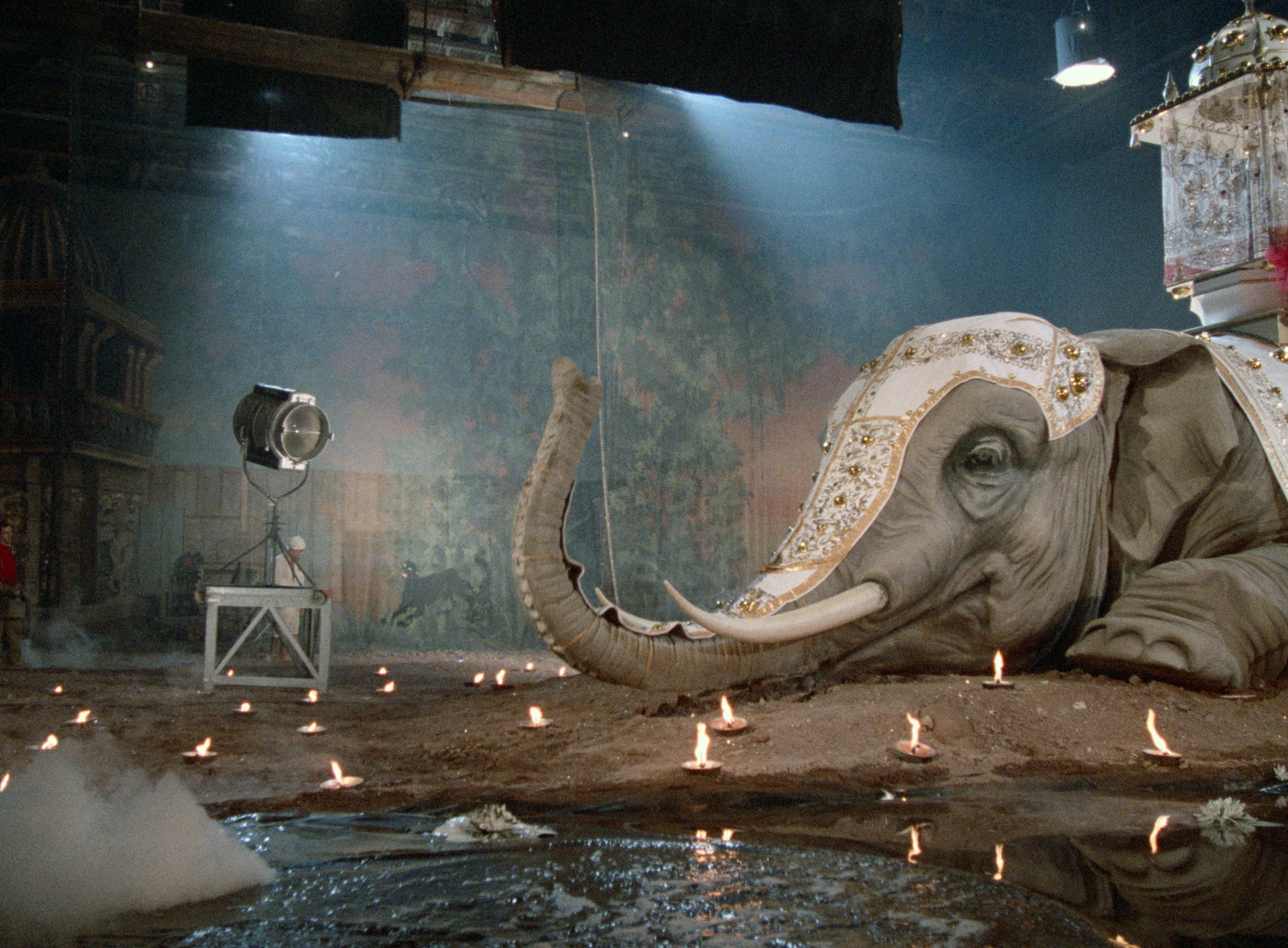
Intervista is a late-career triumph from Fellini, simultaneously parodying and celebrating the artifice of film and the construction of memory through storytelling.
Fellini’s 1987 circus of moviemaking is set in and around the famous Cinecittà studios, the dream factory of Rome and where Fellini made his home as a filmmaker. In the middle of shooting his next project, he is visited by a Japanese television crew for an interview (intervista in Italian). He describes his current project as beginning with a dream, and the story uncoils from there.
The director, his production team, and his interviewers embark on an epic journey looping to the past and present and back again: passing by imaginatively staged TV commercials; reconstructing the fascist era and young Fellini’s first visit to Cinecittà, where he himself conducts an interview with a famous actress; then swooping back to the media and fame-obsessed present, where both Fellinis, young and old, reunite with longtime collaborator Marcello Mastroianni, who then pays a visit to his La dolce vita costar Anita Ekberg. Following a classically extravagant Fellini finale, in a quiet, empty soundstage, the director sighs that his producer asks that his usually gloomy films end with a “ray of sunshine,” punctuated by a crew member, holding a clapperboard, wrapping the film with a “Take One.”
Set at a movie studio, with himself and his stature as main subject, Intervista is rich not only with callbacks across his body of work – a sequence remembering La dolce vita, introducing Marcello Mastroianni as “Snaporaz” (a nickname for his 8 ½ character, used more prominently later in City of Women), plus musical references to The White Sheik, Ginger and Fred, and more – Intervista itself is delightfully cyclical and self-referential, adding to the dizzying sense of time and reconstruction looping around. A fun visual gag is a single ad featuring a very 1980s supermodel plastered all along a subway line, to an absurd degree with the same photo over and over, only for the photography session of that image to take place later in the film. Within that same room, where the art department and set designers work, is a concept art painting of a memorable set piece used in a lipstick TV commercial from earlier in the film, and among the other works-in-progress is a sample piece of wall that bears a striking similarity to the dressing room of the actress young Fellini interviewed.
These feel more as Easter eggs, blink-if-you-miss-it moments, compared to the narrative structure of Fellini’s self-interview, conjuring versions of himself fact and fiction, past and present. Playing with time, the young Fellini walks onto a fascist-era soundstage, as a classic epic is being filmed, only for Fellini today to be in his director’s chair around the corner, speaking with the Japanese camera crew. The 8 ½ parallels come back with the presence of Marcello Mastroianni, who plays a fictional version of Fellini in that semi-autobiographical classic, with three versions of Fellini: fictionalized young man, fictionalized middle-aged actor later in life, and the “real,” more senior Fellini, also with a degree of fiction, operating in a scripted work in conversation with other versions of himself. Within the realm of storytelling, and the dream factory of a studio, all our selves, past and present, real and imagined, come to life, intersect, and collide.
With a crazed energy similar to the surreal City of Women, Fellini has a lot of fun exploring and portraying film and television production as a construct. On sets exterior and interior, the delightfully staged action is one small part of the frame, captured by the cameraman, in turn surrounded by crew members, producers, and director, scattered about the soundstage and up and down scaffolding. Moviemaking is construction, both philosophically and literally, yet this is told without deep cynicism or irony, but an awe and beauty. One of the most striking images of the entire film is within a soundstage, as artists paint a backdrop of a sky, a stunning, convincing opening of possibility, created by painters hanging from manmade scaffolding. It’s a fake natural beauty made by labor, achieved by man.

The power of storytelling to craft one’s memories, or revisit the past, is exhibited both within the fiction of the narrative, and the reality of its performers. One of the films-within-a-film is Fellini’s experience visiting visiting Cinecittà as a young man, recreated through the casting of himself (from a lineup of actors), to finding period-accurate streetcars, to re-dressing a dumpy old building into the Casa del passeggero, bringing the past to vibrant new life, filling in the blanks where his memory fails him. His past, as he reveals in his (self-constructed) interview within the film, is what he conjures up, and becomes the truth, accurate or not.
Film also holds memories as a time capsule, embodied through the touching reunion of La dolce vita stars Marcello Mastroianni and Anita Ekberg. Over two and a half decades after their iconic performances, Mastroianni magicks up a screen and projector from nothing, and they are mesmerized by their famous Trevi Fountain scene. There’s a poignancy as they today, now with gray hairs and wrinkles, gaze upon their youthful selves, immortalized on celluloid.
Intervista offers a transcendent perspective, and introspection, on creation and memory. The act of moviemaking is a fake one, a circus of coordination and cooperation, but the end result is a beautiful, timeless synthesis: like a sublime, impossibly blue sky, painted by man.
Leave a Reply