
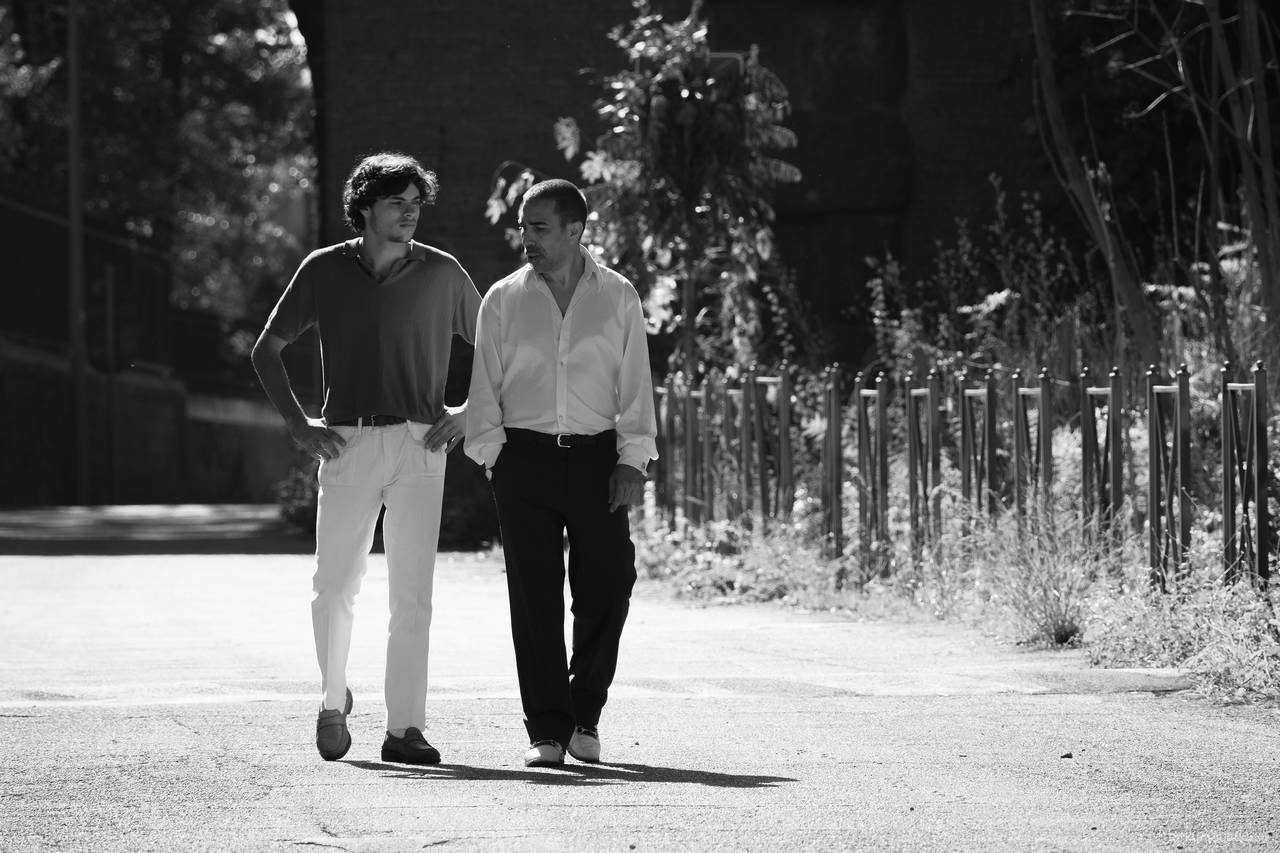
Daniele Costantini’s Accattaroma draws inspiration from the works of Pier Paolo Pasolini as it follows one man and an ensemble of young adults whose paths intersect throughout the streets of Rome.
Starting from the Via del Mandrione, a road connecting the city center to its outskirts, the middle-aged Vittorio is en route to a job, following instructions to go to the Rio della Grana. Along his walk, he encounters a trio of young men, who then in turn hang out at a bar run by the grumpy Stella, who plays host to a variety of other Romans, and the story continues scattering across different scenes and scenarios, from a bickering couple to a mysterious woman dancing the cha-cha.
As the film’s title suggests, it is replete with Pasolini parallels, including stories and character names from his films Accattone, Mamma Roma, and La ricotta, plus references as subtle as the mythical locale of the Rio della Grana, named after one of Pasolini’s unfinished novels. Vittorio (who shares a first name with the character Accattone) tells Ruggero the story of Accattone, the movie, who then recounts it to his friends; and later on, Vittorio recounts Mamma Roma to Maddalena, another namesake from Accattone. At the film’s climax, outside Stella’s bar, where nearly every character is seated, a woman tells the story of the “murdered poet” whose body was found in 1975: the death of Pasolini.
The ensemble, like a snapshot of the Roman young adult scene, is a dynamic world, through which stories and dreams spread through their network like a game of telephone. The starting point and catalyst is all Vittorio though, the older outsider, like an external observer or teacher, whose insights are shared among the youth like a ripple effect.
The timelessness, and timeliness, of Pasolini’s work is conveyed not only through setting, within the Eternal City of Rome, but even through its cinematography: in black-and-white, evoking Pasolini’s early films and the Roman locations of those works. The most explicit hint to our time setting is talk of the euro as currency (placing us at 1999 or after), but there are no cell phones or contemporary signifiers that otherwise clash with this story unfolding, feasibly, in the 1960s of Pasolini.
Accattaroma is very talky, occasionally to the point of being overbearing, as characters interrupt and bicker, slowing down momentum and prolonging the dialogue centering each scene. The unusual structure makes for an interesting experiment, like an imagining of how today’s youth would engage with, and even unconsciously live out, the works of Pasolini. For audiences unfamiliar with Pasolini’s work, Accattaroma likely only has so much impact, but for those coming in with knowledge of his early films and themes, it is a thought-provoking interpretation on how his works can, very believably, still feel true to Rome at any era, past or present.
Leave a Reply