
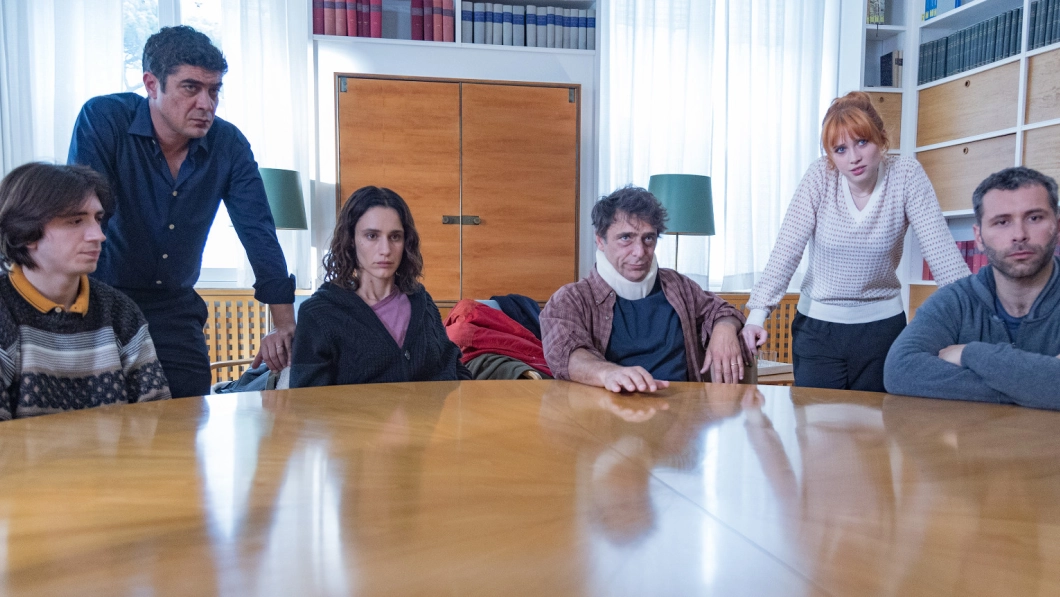
Simone Godano’s Family Matters (Sei fratelli) follows six adult siblings who, after the death of the family patriarch, are reunited to reconcile their father’s estate, as well as their broken ties with one another. Each sibling is in a different stage of life, facing different circumstances, but their reunion wipes away their individual, more interesting, ruffles to paint a broad, underdeveloped picture of a singular family brought back together.
Each sibling’s intro fortunately doesn’t take too long, but once everyone’s back together, as each new narrative checkpoint emerges (where is everyone staying after the funeral, how to handle the business and debts they have inherited, what to do with their father’s body) it’s a tedious, tiring process to work through everyone’s response and the predictable points of conflict, before the group lands on a decision and the next topic emerges. It feels like running the clock to fill in time, so each sibling can have their point of view, but it’s fluff that doesn’t uncover deeper meaning about the characters, or reveal how they grow closer throughout the story.
The most interesting scene comes as they discuss where to place their father’s ashes. A “new” sister, born out of wedlock and previously unbeknownst to the other siblings, recommends the sea, a place she says their father loved. The other siblings scoff that their father hated the sea, but she doubles down that it’s a special locale they spent time at, as father and daughter. Coming from different places, both geographically between Italy and France, plus with different family units with different mothers, the siblings’ diversity of experiences creates a more compelling, though not contradictory, rift that their father lived different lives with each child, and the version of their father one sibling knows may vary from another’s experience.
Their unique accounts would have made for a more nuanced aggregate vision of their father, but outside of this conversation, their individual selves feel like narrative tediums rather than meaningful characterizations. With all six siblings around most of the time, the ongoing checklist of everyone to chime in their response is a surface-level expression of their differences, but nothing digs deeper beyond providing an uninspired take that they may all be different but they’re still family.
Family Matters also frequently employs the jump cut, abruptly pulsing from one shot to the next, typically in scenes of dialogue (this is a drama, not an action flick) creating an impact both jarring and irritating, like hitting fast-forward rather than letting scenes and interactions just breathe. If the effect works as intended, it adds to the film’s overall grating energy of piling on words without substance, motion without meaning.
There is undoubtedly a better movie somewhere in here, but the tedious, predictable rhythm of each scene feels tedious, going through the motions of everyone’s unique opinion when they’re ultimately washed away as inconsequential.
Leave a Reply