
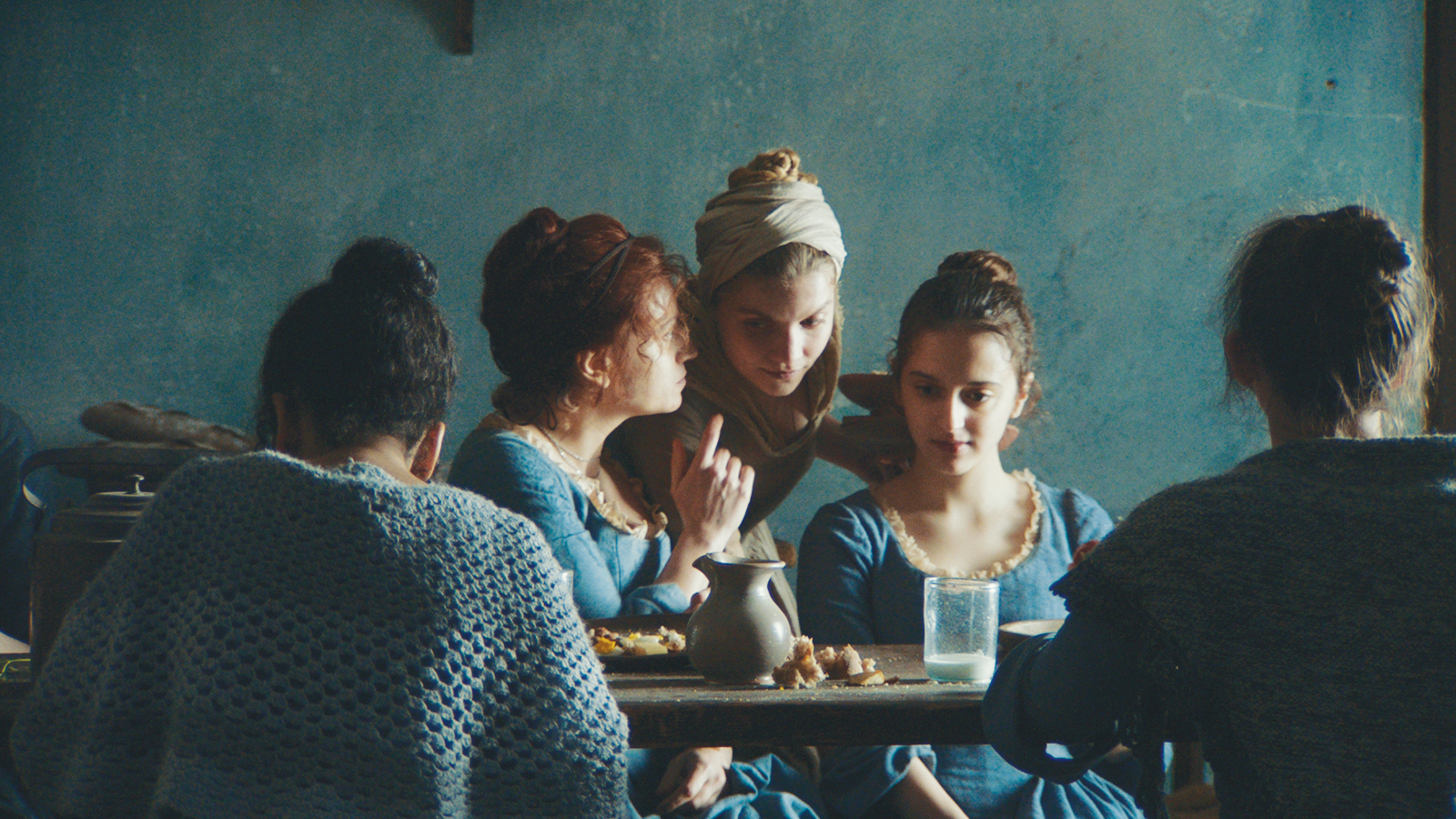
Gloria! (directed by first-time filmmaker Margherita Vicario) is a charming, if not simplistic, imagining of the creation of pop music taking place in 1800, by orphan girls living at an institute.
At the Istituto Sant’Ignazio, a church-run charitable home for orphan girls, teaching music and composition, the orchestra students perform for the parishioners, bringing back in donations to fund the school and continue its operation. Despite their talent and financial leverage, the girls are largely powerless, subject to their teachers and the cruel director, the lowest of them all being Teresa, the mute servant girl. Their fate changes when it’s announced the orchestra will play for the coronation for the new Pope Pius VII, at nearby Venice, and a mysterious crate arrives, bringing a piano into the institute.
In secret, Teresa begins to play, and over time a troupe of girls joins with her, taking turns composing music and bringing in lyrics they’ve written themselves. In typical cinematic fashion, their first rounds of practice are somehow ready-to-go, not showing the craft and discipline to develop a work, but rather the dazzling end product: pop music and sensibilities from our contemporary world, transplanted here to the early 19th century.
The actors work with what they’re given, which is fairly light; the characters don’t have the most depth or inner conflict, and are defined more by their circumstances and standing in life rather than their interior qualities. The spikiest personality is Lucia, the first violinist, who is initially arrogant by her talent, and her eyes on upward mobility, hoping to marry their patron’s son, and is cruel to the servant Teresa, looking down on her as someone lower than herself, and resentful of her undeniable talent. She eventually warms up to her onetime rival, and defacto family of musically inspired girls, who support her even after her own personal tragedy. The story overall though, and what’s asked of the actors, is largely predictable, more focused on the musical performance and finding awe in raw talent, rather than a story that’s particularly challenging or interesting.
The real-life history inspiring the story of Gloria! is that in 1807, religious institutions training female musicians and composers were closed, shutting off the potential of talent and development that they fostered. This need is one innate to their souls, giving ears to the music of such talented girls, as well as one of utility and class, where music, or marriage, is their mode of upward mobility. Lucia comments that the French Revolution could bring about greater change and equality, in hindsight an ironic observation for her to make, given she’s the worst of all the girls to Teresa.
Gloria! is no-doubt a crowd pleaser, imprinting a fun energy and rebellious spirit against repressive institutions, but its pleasures feel more a diversion rather than particularly thoughtful or intellectually compelling – a treat for the ears, if not the mind.
Gloria! is an official selection of the 50th Seattle International Film Festival! Explore more info at siff.net/festival.
Leave a Reply