
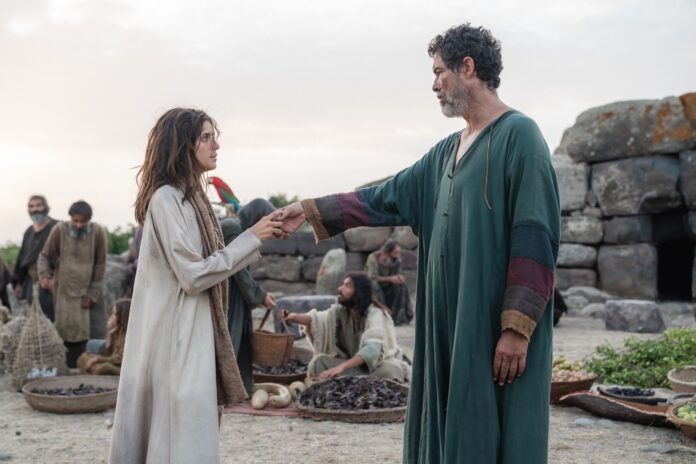
Paolo Zucca’s The Gospel According to Mary is an alternative, sometimes radical, adaptation of the life of the mother of God.
Set before the birth of Christ, Mary (played with versatile range by Benedetta Porcaroli, star of Amanda) is portrayed first as a defiant, rebellious young woman. She refuses to marry, and aspires to read and write, pursuits forbidden to women during that era. She often butts heads with her parents, who try to force her into conformity and a life she doesn’t want; but even as the least devout member of the family, it’s she who rushes the rest along to get to temple on time.
Her main drive is for knowledge and learning, aspiring for enlightenment and experiences beyond what her station in life allows her. She’s seeking someone, anyone, who will take the time to teach a woman about the world, and finds a “master of knowledge” in the older, well-traveled, and kind Joseph (Alessandro Gassman, co-star of An Almost Ordinary Summer). Unbeknownst to them both, a matchmaker brings them together, and they agree upon a chaste union, as teacher and pupil, even separating their wedding bed with a drape.
She compares her unique situation to the Garden of Eden: as one of freedom, to pursue knowledge and self-improvement, away from her parents and the pressures of societal norms, all within the guide of a marriage. She likens her situation to Eve after eating from the Tree of Knowledge, not through guilt or shame, but awareness from entering into a new, enlightened era.
The film takes a tonal shift as the two fall in love, wanting to truly be man and wife, before an angel appears, announcing that Mary will bear a son, conceived by the Holy Spirit. Now tasked with this responsibility, her whole demeanor and romantic feelings for Joseph pivot, no longer desiring her husband but now with the greater purpose, as the mother of God, with no need for knowledge.
This Gospel then takes an even bigger swing, both radical and shocking, by depicting Mary rejecting her chosen path, breaking away from her doctrinal qualities of obedience and dedication to God. She again invokes Eve, who willingly chose to disobey God, and someone to whom Mary is typically presented as a foil: the woman who obeys and the woman who doesn’t. A Mary who denounces her role as mother, and aspires to emulate Eve, prioritizing her interests and not for a greater destiny, is a bold, challenging claim.
The Gospel According to Mary is a thought-provoking story, to consider what Mary’s life was like before becoming the mother of God, and how her life could have taken shape, but some of its narrative turns and characterizations, even if taken just as conjecture, could be off-putting for audiences of faith.
Leave a Reply