
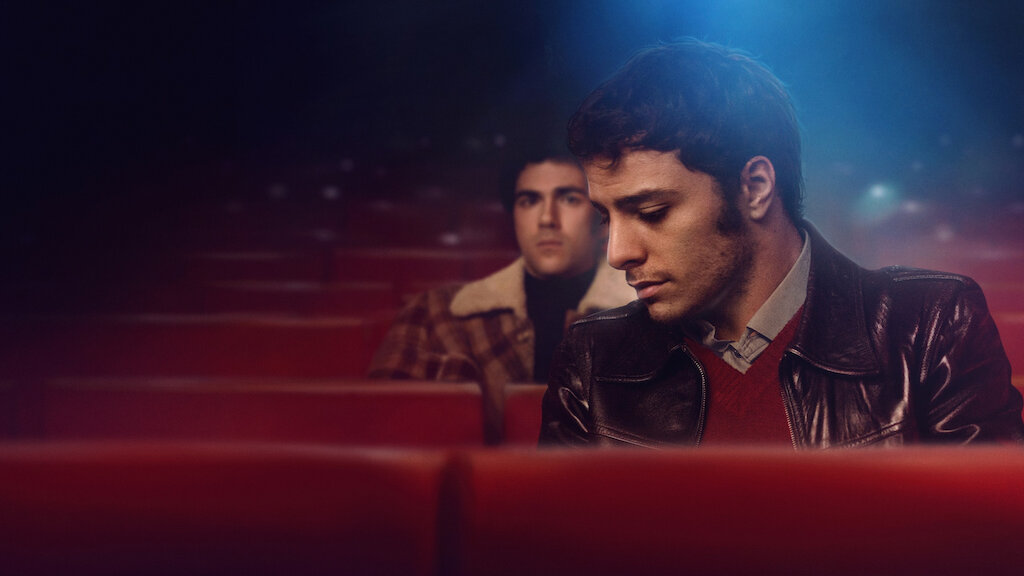
Nuovo Olimpo (directed by Ferzan Özpetek) tells the story of two men’s connection through the decades, after being separated by circumstance in their youth, but each never forgetting the other. Its setting in Rome, the Eternal City, connects the past to the present in this meditation on what might have been, spanning memories and missed connections from 1978 to 2015.
Enea Monte (Damiano Gavino), studying to be a filmmaker, first notices Pietro Gherardi (Andrea Di Luigi) in the crowd during a location shoot in Rome. The two reunite at the Nuovo Olimpo theater, a repertory cinema showcasing classic films, and local cruising spot. They strike up a fast, passionate, connection in a matter of days, but their intended next date is interrupted by an anti-fascist protest, and the violence that ensues, during the Years of Lead era of political unrest. Amid the chaos, the two become separated, Pietro is seriously injured, and their paths diverge, unable to find each other.
As the years pass, Pietro, now a doctor, marries Giulia, and Enea, a successful filmmaker, grows in prominence and falls in love with Antonio. Neither can forget the other, though, and even with their stories unfolding in parallel, missed connections where they almost reunite begin to add up. Circumstance may have torn them apart, but it feels inevitable that destiny will bring them back together.
Inhabiting and revisiting the past is a constant theme in this story of love and longing, reinforced through its Roman setting. As the “Eternal City,” in which the contemporary coexists with the ancient, the Roman Forum looms in the background for many exterior shots, as a tantalizing reminder of the presence of the past, however inaccessible. Similarly, on a more personal level, a specific apartment serves as an ongoing setting: first borrowed from Enea’s friend Alice, as the location where he and Pietro had their early love affair; then later bought by Enea, as a successful filmmaker, and finally revisited by Pietro even later in life, when their lives finally intersect again. Enea’s emotional ties to a physical space, forever linked to the past, as a way to relive, or overcome, powerful memories.
The Nuovo Olimpo theater plays a similar role, both functionally, as a location revisited over the years, as well as the role of a repertory cinema. Showcasing a variety of classic films, including Nella citta l’inferno, Mamma Roma, The White Sheik, there’s a sense of replaying the past, reliving stories already told, and finding comfort in that familiarity. The cinema is also a refuge and meeting place for gay men in the 1970s, a time when homosexuality was still under attack from the state. It is a safe space, physically, to inhabit, as well as emotionally, where cinema and fantasy provide a comforting, albeit imagined, alternative to the often violent reality.
Rome is filmed beautifully, with rich colors and smooth camera work, creating a similar mood and impact of Naples in Veils (an earlier film by Özpetek, also shot by Gian Filippo Corticelli). The camera eases in and out of spaces, following Enea through streets ancient and contemporary, and peeking around street corners. Rome is like a geographic scrapbook, with buildings and settings rich with memory, where any turn can reawaken the past.
Leave a Reply