
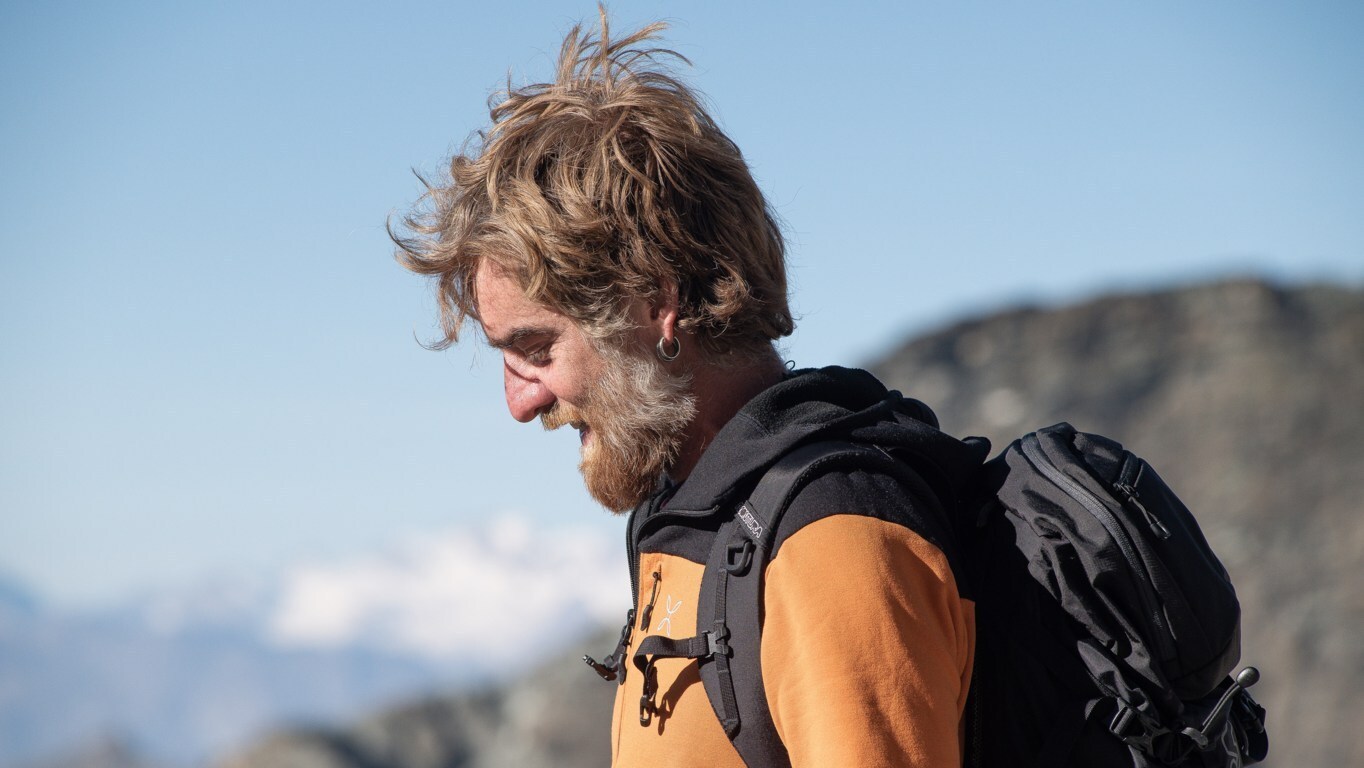
Paolo Cognetti’s non-fiction Fiore mio (A Flower of Mine) is a portrait of the Alpine landscape and the people who inhabit it.
The story is framed by Cognetti, accompanied by his faithful dog Laki, trekking from the valley up to the mountains’ peaks, making stops to conduct interviews at key points along the way. He speaks with a childhood friend who now runs a vegan yoga retreat; a seasoned mountaineering veteran and skilled carpenter; a Nepalese man who’s found new purpose in his life in the Alps; and a young woman who runs a refuge, finding home within a shared, lived-in space.
This film feels very much in conversation with The Eight Mountains, both the novel by Cognetti and its cinematic adaptation by Felix van Groeningen and Charlotte Vandermeersch. The chosen life up in the mountains, largely a solitary existence, mirrors that of Bruno in The Eight Mountains, and is here further elaborated through a diversity of perspectives and standpoints of this way of life. The films even share a cinematographer, with stunning work by Ruben Impens, capturing the majesty of this setting and mankind’s place within it.
The exploration kicks off (somewhat inelegantly) as Cognetti notices the springs at his home are running dry, and he wonders where the source of water begins. Through his journey up the mountains and encountering its people, there is an underlying theme of climate change and the ecosystem shifting, but the film is never explicit or heavy-handed with a particular message or agenda. The individual subjects speak their truth, experience, and perspective, and the audience is given space to connect the dots and draw their own conclusions.
The film’s editing is like a visual meditation, where each interview is followed by exterior shots, venturing further up the mountains, accompanied by a mellow, contemplative musical score by Vasco Brondi (himself an interview subject, in one of the film’s final settings). The audience is given psychological space to process and reflect, taking in the poetry of the landscape and the meaning it carries for its people.
Where in The Eight Mountains, from the perspective of Pietro, Bruno’s choice to stay in the mountains feels like running from society, but here in Fiore mio – from the viewpoint of the mountaineers – the spiritual power of this way of life is an individual pursuit. The people here are not fleeing from something but for themselves, choosing a life completely distinct from modern technology, free from capitalism, and utterly captivating.
Leave a Reply