
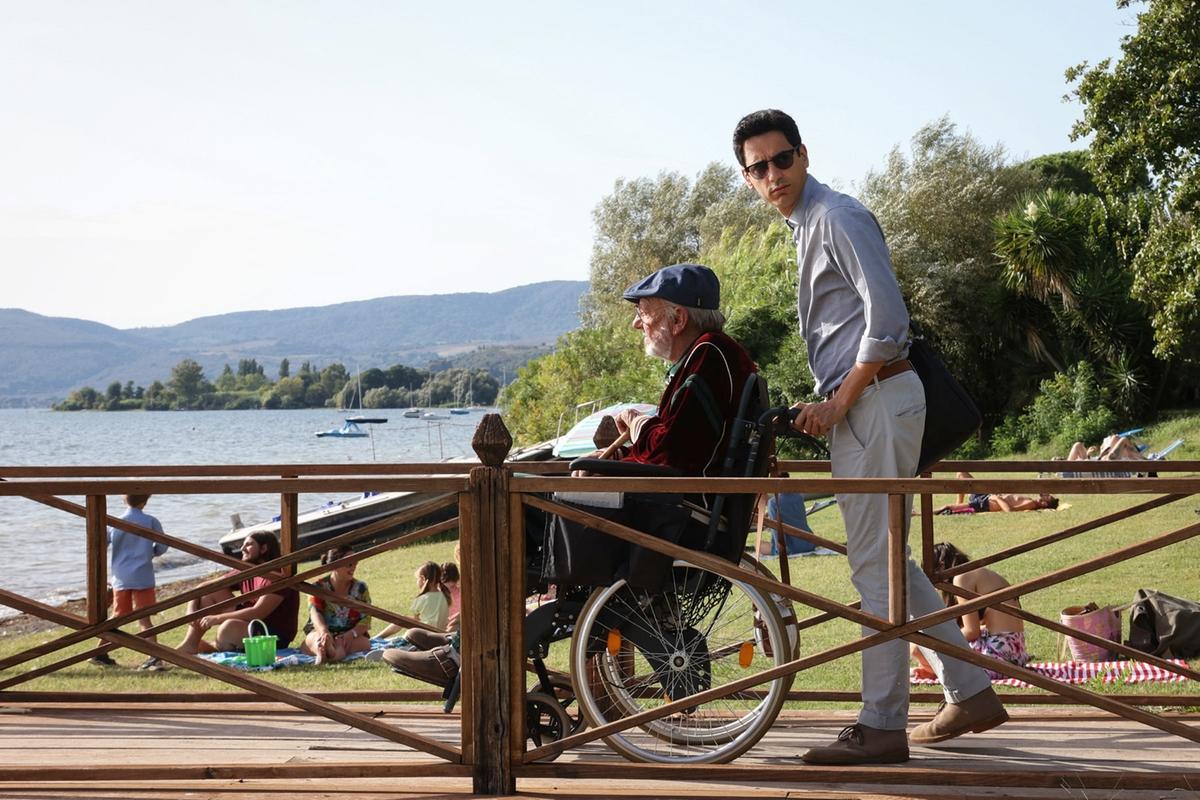
Alessandro Bardani’s comedy-drama The Best Century of My Life (adapted from the theatrical piece he co-wrote with Luigi Di Capua) is a predictable road movie starring an odd couple, young and old, in which each learns a valuable lesson from the other. Its sentimental message is both familiar and expected, while somehow self-contradictory.
The story’s foundation is a real-life Italian policy, in which the identity of mothers who choose adoption cannot be revealed to their children until reaching 100 years of age, to protect her identity privacy, which as a result leaves their descendants in the dark on their family history, realistically through the end of their lives.
Gustavo is one such exception, being over 100 years old, living at a convent and under the care of nuns. The young man Giovanni, whose biological parents also chose adoption, is part of an agency advocating on the rights of adopted children, seeking to overturn the current policy, with Gustavo’s help to provide testimony. He escorts Gustavo from his home to speak before his association, and along the way, the unlikely pair embarks on a road trip of misadventures.
The gap between young and old leads to many predictable scenarios: Gustavo pushes Giovanni to flirt with women; when Gustavo steps out at a gas station, Giovanni gets behind the wheel for the first time in years, and crashes into the autogrill. The elder gentleman as a prickly, playful rascal serves as a foil to the uptight, high-strung younger man, creating an all-too-familiar dynamic.
What makes less sense is how the story posits a life well lived: Giovanni believes to not know one’s biological identity is to be incomplete, while Gustavo couldn’t seem to care less about his parents. He encourages Giovanni to make amends with his adoptive mother, focusing on the life he has, rather than yearning for something long since gone. But on Gustavo’s side, he makes no indication of what his life entails, or what has meaning to him, outside of a mythic encounter he claims to have had with Hollywood actress Rita Hayworth. If one’s biological past matters less than the attainable family and potential for ahead for adopted children, Gustavo gives no clues that he found his life fulfilling regardless.
Perhaps the film’s greatest success is its original song playing in the main titles and end credits, “La vita com’è” by Brunori Sas: a thoughtful, reflective piece transitioning the story from a flashback (Gustavo’s youth) to the present day, spanning the decades through a montage of archival footage and historical moments. It suggests pain, wisdom, and experience from living through a century both devastating and remarkable, a promise of the perspective from someone who’s truly seen it all, which never quite pays off.
The Best Century of My Life is easy to watch, with familiar archetypes and unchallenging ideas, though its lack of insight and perspective doesn’t live up to the potential of its scenario.
Leave a Reply